

What is RFID?
RFID stands for Radio Frequency Identification and describes the automatic identification without touch of objects.
The first RFID products were used end of the 2nd world war. There a secondary radar served for the friend's enemy's recognition.
With the first, commercial applications in the 1960s the ranges of application expanded steadily (legacy systems, animal marking, street toll systems, access controls etc.).
Main components of an RFID system
A typical RFID system encloses the following main components:
- Chip with antenna (RFID tag or also called transponder)
- Reading and writing device with antenna (scanner or reader)
- Integration with servers, services and other systems like. e.g., cash systems or legacy systems (SAP etc.).
Passive tags and Active tags
One can distinguish in principle the RFID tag (transponder) in 2 categories: passive tags and active tags.
An RFID tag exists of a chip with a simple processor, an antenna and a memory.
Passive tags
Passive tags cover their energy from the received radio waves. The stored data can be selected. In addition, the storage capacity and the range of the antenna are lower than from active tags. Hence, it is stored mostly only of the EPC (electronic product code) on the passive tag. Advantages are the nearly boundless life span, the lower size and weight and a clearly lower price of the passive tag in comparison to the active tag.
Active tags
Active tags dispose of an own battery to the energy supply. The memory can be read and be described. The storage capacity and reach are substantially bigger. Disadvantages more actively of Tag are a limited life span, the size and the clearly higher price in comparison to passive tag.
RFID Reader
Readers (mobile Scanner oder Fix Reader) appear in varied form. An example are fix installed readers in multi-storey car parks, in the ski lift or also in the gate to a goods camp. These fixed readers are used primarily where the "product" must be recognised at a firmly defined place.
Another example are the mobile Reader, which are used at the supermarket, animal marking, compilation of an inventory or similar.
Communication between RFID Reader and RFID Tag
On the RFID tag (transponder) information (e.g., the electronic product code) is stored. If the tag receives a certain signal by a reader (e.g., a gate in the goods camp) he redirects this information over the antenna to the reader. The actualisation of product information is thereby possible in connection with a data bank on a real-time basis. Thus, for example, the topical place of residence of a certain product is always available. NO view contact is necessary between the tag and the reader.
Frequencies
The right frequency plays a significant role in the entire solution, from the RFID tag to the software application. Each frequency range has advantages and disadvantages in the application. However, one should carefully weigh the individual performance characteristics! It is important to know whether a tag should be read exclusively or read/write. Specific technologies such as Legic or Trovan should be clarified beforehand.
RFID technology is divided at the moment into 4 main categories. The frequency ranges LF, HF, UHF and SUHF have in each case own specifications which show its advantage in the different operational areas.
LF (Low Frequency) 119 Khz – 135 Khz
- Advantages: reliability, high tolerance compared with liquids, textiles, wood and aluminium
- Disadvantages: low reading reach, small memory, slow data transfer, big tag and antennas
- Typical application areas: animal marking, access control, logistics, distribution, waste industry
HF (High Frequency) 13,56 Mhz
- Advantages: high storage capacity, bulk reading, quick data transfer, small Tag and antennas
- Disadvantages: low tolerance with metals, middle reading range
- Typical operational areas: health care, quality assurance, libraries, delivery services, luggage inspection
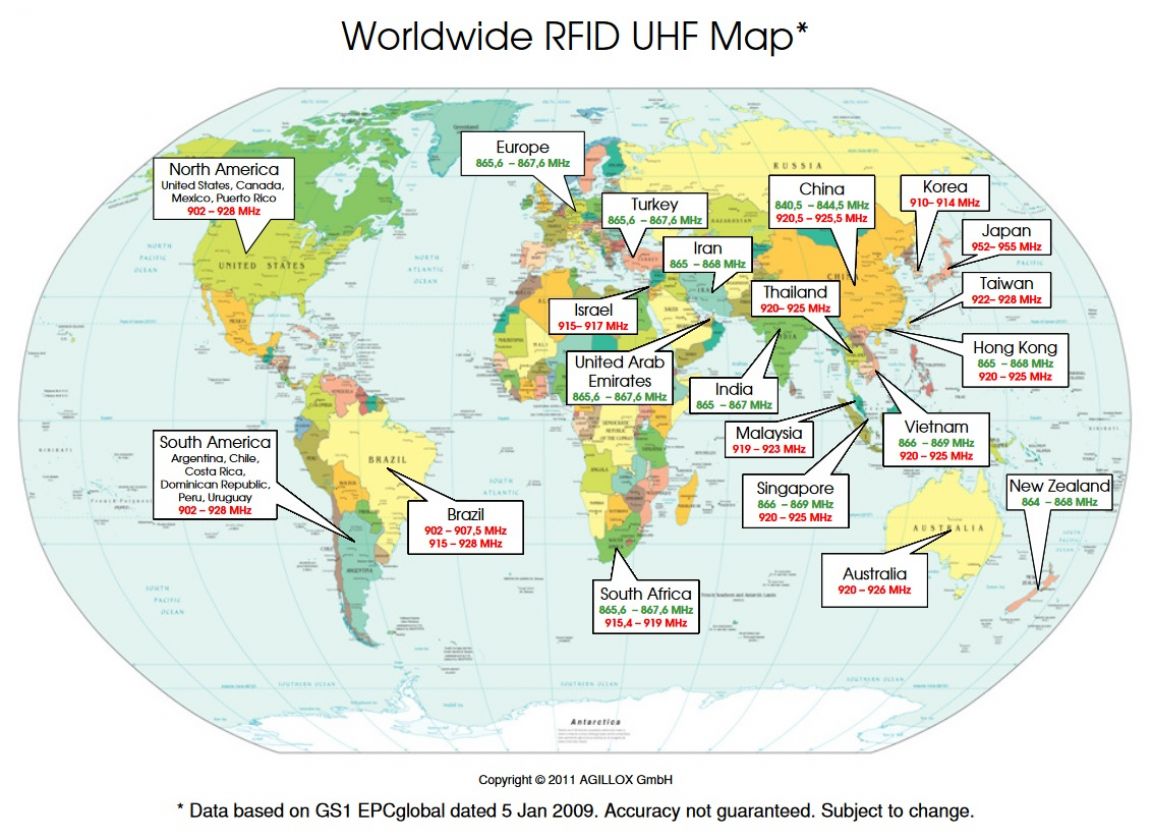
UHF (Ultra High Frequency) Europe 865 - 870 Mhz / USA 915 Mhz
- Advantages: high to very high reading reach, bulk reading, high storage capacity, speed
- Disadvantages: very low tolerance to liquids and metals
- Typical operational areas: asset management, logistics, automotive, production, automation
- Worldwide RFID UHF Map
SHF (Super High Frequency) 2.4 GHz (primarily in the USA)
- Advantages: extremely long reading reach, bulk reading, high storage capacity, speed
- Disadvantages: hardly solutions suited for practise in Europe
- Typical operational areas: access control, toll systems, container identification
Strengths and chances of RFID technologies
Already today industry and trading companies have put in place the future technology RFID because it optimises their commercial processes, lowers operation all costs and can raise the security of products. These are obviously advantages for the end consumer. During the last 5 years an exhaustive use of RFID has developed steadily. This among other things is due to the reduction of the unit cost for transponder and the steady advancement of technical solutions and improvements of the different technologies.
Barcodes will still continue in the market
Still is not to be assumed from the fact that RFID transponders will substitute the barcode in trade and logistics overnight. Rather it is expected that the technologies exist in parallel for a longer period. The industry is demanded to develop hybrid systems which implement both technologies in a device. The first systems are already at the market which allow a parallel processing of barcode and RFID.
Besides, the RFID technology compared with the barcode offers numerous advantages: Data capture without touch without view contact on a real-time basis, concurrent recognition of several transponders (bulk reading), insensitiveness with dirt and other damages, enlarged memory for data as well as the possibility to change already stored data.
RFID will be present in almost all applications of our life
By the application of the RFID technology chances arise for all areas of the public life, whether economy, science, public facilities or spare time. RFID can optimise processes, back pursuit eases, authenticity guarantee which improve security of products or simplify access controls. In addition, it is possible to develop autonomous systems with the help of the technology which can react independently and decide. If for example, shelves are equipped in a goods camp with RFID readers, it is automatically recognised, when the continuance goes to the bending and a repeat order is ordered.
RFID is flexibel and barcodes are static
As a last would be mentioned that the most unequivocal difference between barcode and RFID tag lies in the fact that a barcoode (once printed) remains a static data medium. It cannot be changed any more. An RFID tag, however, can be provided any time with the newest data and becomes therefore the dynamic data memory which can be re-written any time and changes are stored. Therefore the process chain with RFID "lives"!